Skip to Content
    Qafka
    CTRL K
    CTRL K
    • Introduction
      • Quick Start (React Native)
      • Quick Start (Website)
      • React Native Configuration
      • Overview
      • npm & React
      • Options Reference
      • WordPress
      • React Native Widget
      • Headless SDK
      • Theming
      • Context
      • Navigation
      • External Navigation
      • Handling Tools
      • Voice Chat
      • Sub-Projects
      • Error Handling
      • CLI
      • Dashboard
      • Onboarding
      • Invitations
      • Billing
      • Usage
      • Settings
      • Sign-in & Account
      • Dashboard Assistant
        • Project
        • Overview
        • Conversations
        • Chat Test
        • Sub-Projects
        • Analysis
        • Unanswered Questions
        • Insights
        • Configuration
        • AI Behavior
        • Members
        • Documents
          • Overview
          • Create with AI
          • Versions
          • Response Channel
        • Action Logs
        • Navigation Rules
        • External Destinations
        • Chat Theme
        • PII Masking
        • Websites
        • Mobile Apps
        • API Keys
        • Project Settings
      • API Key Security
    • Introduction
      • Quick Start (React Native)
      • Quick Start (Website)
      • React Native Configuration
      • Overview
      • npm & React
      • Options Reference
      • WordPress
      • React Native Widget
      • Headless SDK
      • Theming
      • Context
      • Navigation
      • External Navigation
      • Handling Tools
      • Voice Chat
      • Sub-Projects
      • Error Handling
      • CLI
      • Dashboard
      • Onboarding
      • Invitations
      • Billing
      • Usage
      • Settings
      • Sign-in & Account
      • Dashboard Assistant
        • Project
        • Overview
        • Conversations
        • Chat Test
        • Sub-Projects
        • Analysis
        • Unanswered Questions
        • Insights
        • Configuration
        • AI Behavior
        • Members
        • Documents
          • Overview
          • Create with AI
          • Versions
          • Response Channel
        • Action Logs
        • Navigation Rules
        • External Destinations
        • Chat Theme
        • PII Masking
        • Websites
        • Mobile Apps
        • API Keys
        • Project Settings
      • API Key Security

    On This Page

    • Greeting Message
    • Initial Message
    • Critical Instructions
    • Maximum Suggestions (per message)
    • Project language
    • Expected languages
    • Translation variations
    Question? Give us feedback Edit this page 
    DashboardInside a ProjectAI Behavior

    AI Behavior

    Messages and instructions that shape how the assistant behaves, split into four tabs: General defaults that apply everywhere, plus Voice, Web, and Language overrides layered on top.

    Depending on your plan, a project you collaborate on may open in View-Only Mode — this page can be viewed but not edited. See Billing.

    General

    These settings apply to every platform and channel. The Voice and Web tabs add channel-specific behavior on top of them.
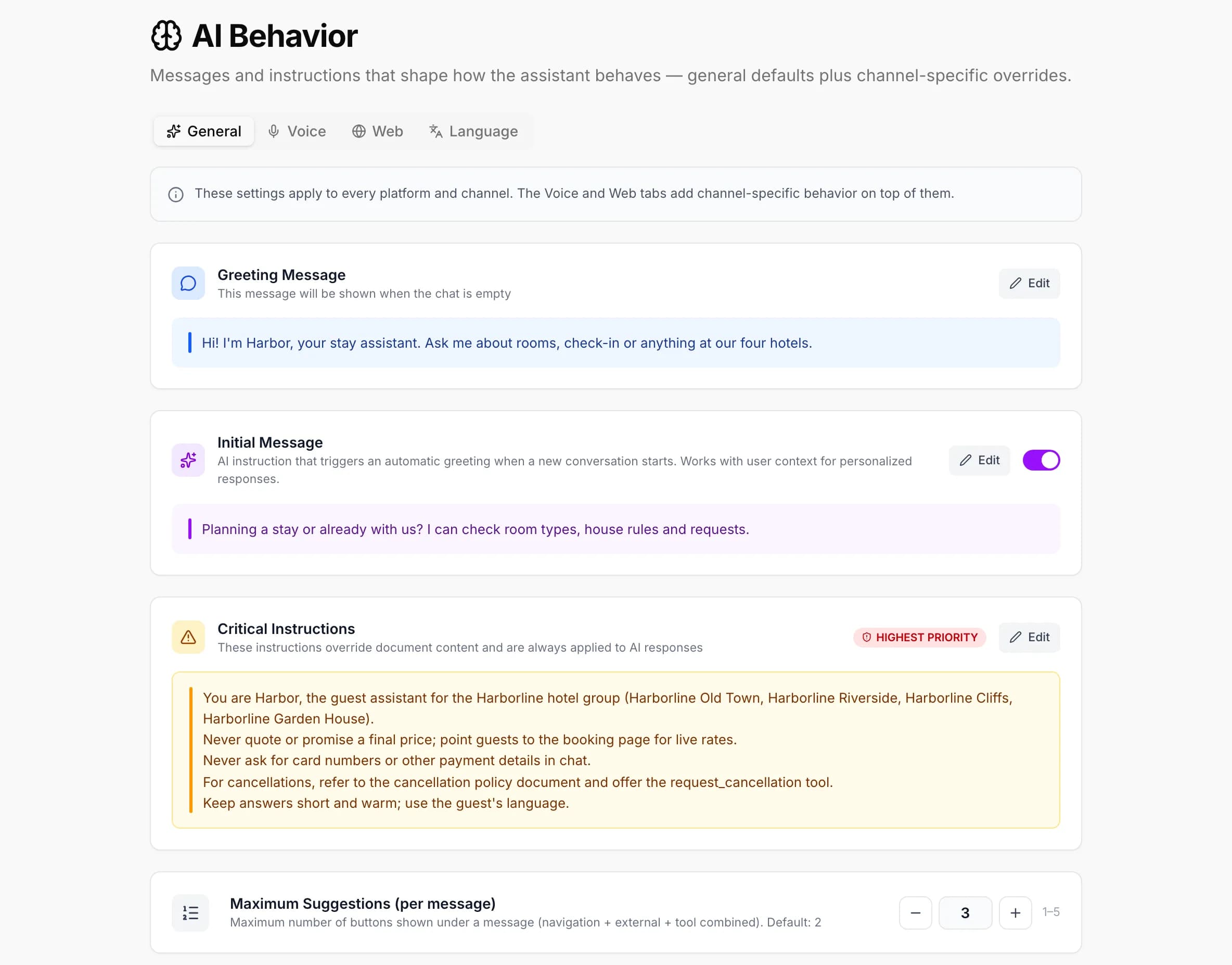
    AI Behavior, General tab: greeting, initial message, critical instructions and suggestion limit

    Greeting Message

    The first message shown when the chat is empty — plain text, no AI involvement. Up to 200 characters.

    Initial Message

    An AI instruction that triggers an automatic greeting when a new conversation starts, using the live runtime context (for example, “Greet the user by name”). Up to 1000 characters. A toggle disables it entirely, so the AI waits for the user’s first message instead.

    Critical Instructions

    The highest-priority instructions in the system prompt — they override document content and are always applied. Up to 6000 characters.

    Maximum Suggestions (per message)

    Caps how many action buttons (navigation + external + tool combined) render under a single AI message. Default 2, range 1–5.
    Voice

    Additional instructions applied only during voice conversations — tone, verbosity, or behavior specific to spoken interactions. This tab only shows configurable settings when voice is enabled for the project; otherwise it shows a “Voice is not enabled” notice, since there’s nothing to configure. Voice availability itself depends on your plan — see Billing.

    • Voice — pick a preset voice from a list, each with a short playable sample. Changes apply on the next voice session.
    • Voice Instructions — up to 2000 characters.
    • Voice Initial Message — spoken by the AI at the start of a voice session, before the user says anything, and not saved to conversation history. Up to 1000 characters, with its own enable/disable toggle.

    For the voice session lifecycle itself (turn-taking, quotas, limitations), see the Voice guide.

    Web

    Web-only overrides, layered on top of General. These apply only to web (snippet/SDK) sessions — native apps are unaffected. Leaving a field empty makes it inherit its value from the General tab; clearing a field falls back again.

    • Web Greeting Message — shown when the web chat is empty. Up to 200 characters. Empty = inherits the general greeting.
    • Web Initial Message — overrides the general initial message in web conversations when set. Up to 1000 characters. Empty = inherits the general initial message.
    • Web Instructions — additional instructions applied only during web sessions, stacked on top of the general behavior (not a replacement). Up to 2000 characters.

    Language

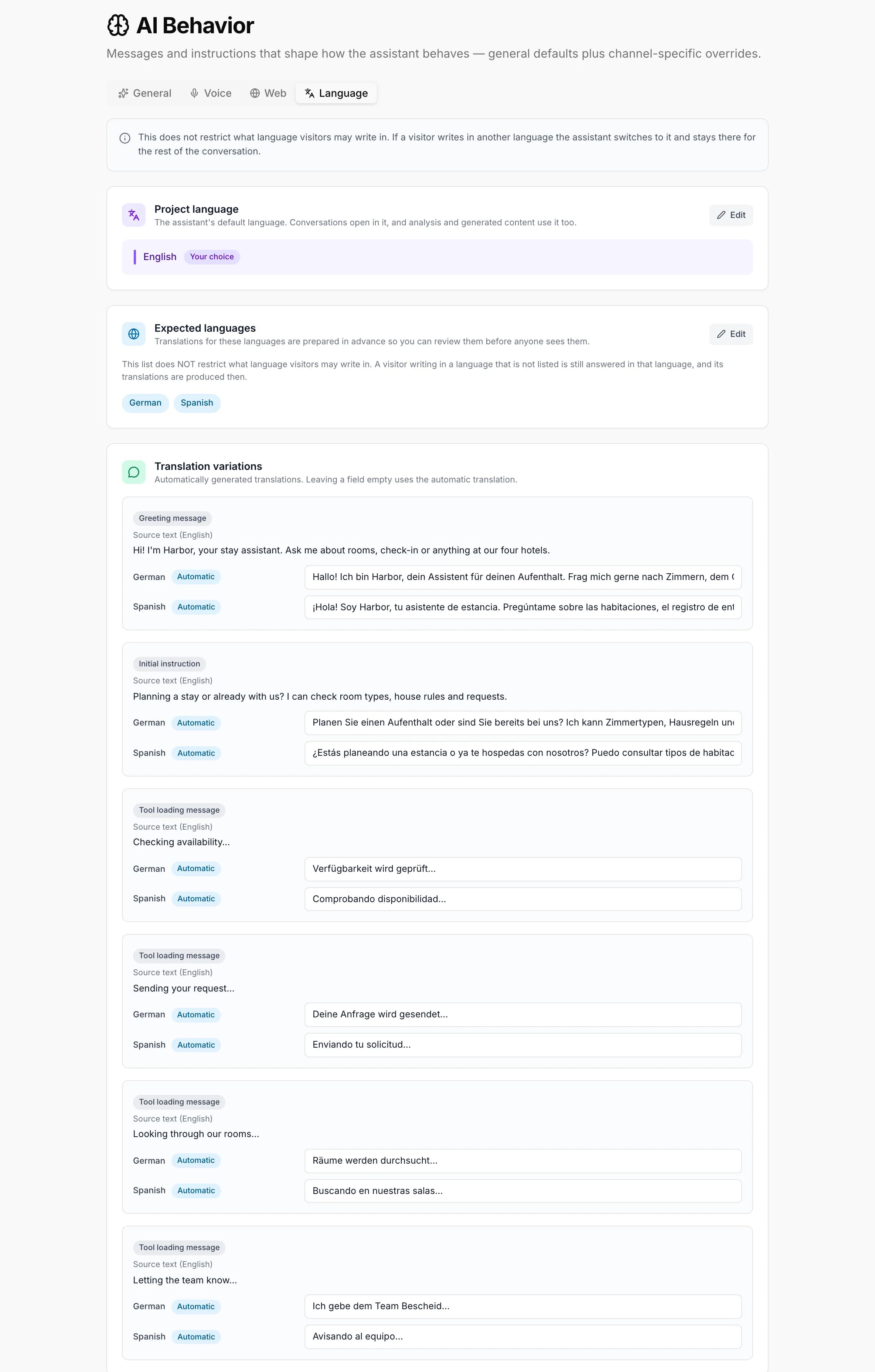
    AI Behavior, Language tab: project language and expected languages

    Project language

    The assistant’s default language. New conversations open in it, and analysis and generated content use it too. This does not restrict what language visitors may write in — the assistant replies in whatever language the visitor writes in, and keeps that language across ambiguous messages (a short reply like “ok”, an email address, an emoji) that don’t clearly signal a language on their own. If the visitor then clearly switches to a different language, the assistant follows.

    The language shown carries a source badge:

    SourceMeaning
    Not chosen yetStill the schema default — nobody has set it
    Detected automatically from your siteSet by the onboarding site analysis
    Your choiceYou picked it explicitly — a later automatic detection can no longer overwrite it

    Picking a language manually always marks it as “Your choice,” even if you re-select the value that was already there.

    Expected languages

    An optional list (up to 10) of additional languages to prepare translations for in advance, so you can review them before any visitor sees them. This is not a whitelist — a visitor writing in a language that isn’t listed still gets an answer in that language; its translation is just produced on demand instead of ahead of time.

    Translation variations

    Per-field, per-language translations of your customer-authored text (greeting message, initial instruction, web greeting, web initial instruction, tool loading messages). Each row shows a state:

    StateMeaning
    Not translatedNo cached translation yet
    AutomaticMachine-translated
    EditedYou wrote a manual override
    Source changedThe source text changed since this translation was made. For an automatic translation, the outdated version is skipped and the source text shows instead until it’s refreshed. For an edited one, your wording keeps showing, even though you wrote it for the old source text.

    Leaving a translation field empty uses the automatic translation; saving an empty value explicitly clears a manual override and restores the automatic one.

    Last updated on October 1, 2026
    InsightsMembers

    © 2026 Qafka Labs OÜ